I have recently been re-reading C.S. Lewis’ The Abolition Of Man – an absolute masterpiece of prophecy and prose. In it, he argues for the existence of objective moral value, and shows that (in 1940) it was in grave danger of being cast aside for some sort of purely rational and ‘scientific’ view of morality which necessarily reduces all moral judgement to subjective opinion. Along the way, he visits Plato, Aristotle and Augustine, who all have similar conceptions of virtue, and especially, how it is brought about in a child. If some things really are, objectively true, good, or beautiful, then man must be trained to esteem them as such, and to praise them properly.
“St Augustine defines virtue as ordo amoris, the ordinate condition of the affections in which every object is accorded that kind of degree of love which is appropriate to it.”
“Aristotle says that the aim of education is to make the pupil like and dislike what he ought”
From Plato: “The ugly he would rightly disapprove of and hate while still young and yet unable to apprehend the reason, but when reason came the man thus nurtured would be the first to give her welcome, for by this affinity he would know her.”
So Lewis summarises, “The little human animal will not at first have the right response. It must be trained to feel pleasure, liking, disgust, and hatred at those things which really are pleasant, likeable, disgusting and hateful”.
It is not just morality in question for Lewis, but also its necessary connection to aesthetic value. Objective beauty is just as important as objective truth and goodness – or rather – they are all three facets of the same reality.
It follows that the contemplation of the good is a form of training in virtue. This can be done through art, and particularly through literature. Good literature will commend truth, beauty and goodness through its story and its characters. It will illustrate why evil is destructive and why good is worth striving for. It will give insights into the human condition and it will raise our moral gaze. Where it must deal with lies, ugliness and evil (and no real story can avoid these), it will not commend these things but rather show them for what they are and teach us to revile them.
I turn now to dwell on two works I have recently read that violate these principles.
Murakami’s Kafka On The Shore made me deeply uncomfortable. For a time, I wasn’t able to understand why this book kept bubbling up to the surface of my thoughts. It is representative of bad literature in two main ways: Firstly, it is absurd. It makes no sense and even intentionally prevents sense-making at times. Secondly, it is perverse and gratuitous in its description of violence and lust and does not attempt to portray any moral aims or struggles of its main character. If it were a work of visual art, it would be noted for its lack of coherence, its ugliness and its rule-breaking.
Franz Kafka’s The Trial struck me as illustrative of the despair of truth. The protagonist is accused of an unknown crime by a sham court. Although he initially derides the court as illegitimate, he allows it to gain legitimacy as he is slowly drawn in to the process of the trial until he eventually submits to a death sentence. We never find out what he is accused of, or even any real details about anything related to the trial or the court system.
On first pass, the reader may glean insights into the maddening frustration of modern bureaucratic and legal systems, or of powerlessness against anything not understood. On second, the reader may begin to see an allegory of society – illegitimate and ultimately meaningless systems we are born into that gain their power by our submission to them. On third, the reader surrenders to the meaninglessness of both the story and its explanations and welcomes the feeling the author intends to engender – a kind of rage that nothing makes sense. The book does at least succeed in this aim. Apart from being very poorly written, hard to read, gratuitous, devoid of beauty, moral example, insights into the human condition and depth of character, I fundamentally disagree with the thesis.
The point of a work like this is to illustrate meaninglessness. Samuel Beckett’s Waiting for Godot is in much the same category. A despair of truth underlies its philosophy. And the point is well made, but here’s the thing: the point doesn’t need to be made. It’s false. All the authors succeed in doing is subverting an art form to say nothing and be wrong in the process.
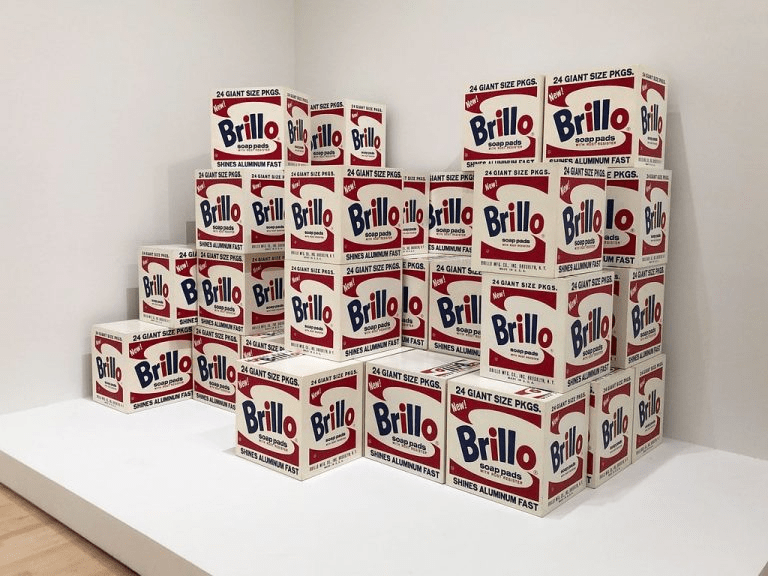
The parallel to visual art springs to mind. A child can look any of Marcel Duchamp’s The Fountain, Andy Warhol’s Brillo Boxes, Jackson Pollock’s Blue Poles, and say simply that they are ugly and devoid of meaning – bad art. Yet as humans we have the tendency to ooh and aah at nothingness. The phenomenon is most obvious in works of visual art, but can easily apply to literary art too. As an aside, I am beginning to realise that ‘the emperor’s new clothes’ has the most explanatory power of all the fables for life. Essential to the grift of the New Clothes Crowd is the creation of a feeling of inferiority in anyone who dares to dissent. Anything novel must be valuable, and to disagree is to out oneself as a fool. This is the power that gives art like Kafka’s The Trial social value. Yet, as with the fable, a child’s instinct for farce is our most useful weapon.
Why does all this matter? Why rant about books into the void? Because a philosophy of meaninglessness is insane and dangerous. It’s not just in these particular works, it’s in the air we breathe as a culture. Thankfully, we’ve progressed beyond modernism and even post-modernism and these ideas have less of a hold than they used to. But they have not been effectively replaced with anything yet. Our culture flounders around looking for meaning and has been latching on to a random succession of causes for hope.
When faced with the mystery of life, with things that don’t make sense, we are presented with a fork in the road. On the one hand, we can affirm that underneath it all, there is a fundamental sense-making reality. That there is meaning behind it all. This leads to the embrace of paradox and mysticism as the key to faith. That way lies sanity.
On the other hand, we can despair of truth. Underneath it all, there is no meaning, no sense-making reality. This leads to the embrace of rationalism, and every instance of paradox proves the rule. That way lies madness.
The theme of meaninglessness is an interesting one – well worth spilling ink over. And I get that it is a clever trick to use an essentially meaningless piece of art to convey this. But I suggest that what would make the treatment of such a topic good literature would be the placement of this worldview against ultimate reality. Dostoevsky tackles one aspect of this in Crime and Punishment, where his protagonist, initially asserting moral relativism, commits a heinous crime and over the course of the story inexorably collides with moral reality.
Back to Lewis (to whom else shall we go?).
Lewis wrote (in my opinion) his greatest novel, That Hideous Strength, as a companion story to the themes of The Abolition Of Man. Throughout his whole space trilogy, he develops this idea of sin as being ‘bent’. There is a profound passage where the protagonist Mark is placed in an ‘objectivity room’, where everything is a tiny bit off. The angles, the colours, the patterns have all been deliberately perverted in some small way. In the turning point of the book, Mark finally beholds and understands Goodness for the first time:
“As the desert first teaches men to love water, or as absence first reveals affection, there rose up against this background of the sour and the crooked some kind of vision of the sweet and the straight. Something else – something he vaguely called the ‘Normal’ – apparently existed. He had never thought about it before. But there it was – solid, massive, with a shape of its own, almost like something you could touch, or eat, or fall in love with. It was all mixed up with Jane and fried eggs and soap and sunlight and the rooks cawing at Cure Hardy and the thought that, somewhere outside, daylight was going on at that moment. He was not thinking in moral terms at all; or else (what is much the same thing) he was having his first deeply moral experience.”
My main reflection was on the importance of good literature and its value in shaping our moral sensibilities, but this has greater societal implications. Our society is healthy when what is true and good and beautiful is held up as worthy of praise and contemplation. Yet we have a society that parades perversity on the street, and seeks to #normalise what is intrinsically abhorrent and evil. We have forgotten the definition of ‘Woman’. Worse, we call men, women and women, men. Queerness and deviancy is praised.
Lewis’ prophecy came true.
“Woe unto them that call evil good, and good evil; that put darkness for light, and light for darkness; that put bitter for sweet, and sweet for bitter!” – Isaiah 5:20
By way of admission, some may say that ‘mysticism’ and ‘paradox’ are conveniently slippery terms that I am using to avoid confrontation with an uncomfortable reality. It is possible that my a-priori belief in God and in a meaningful universe could be wielded in the very same way that a materialist wields his own assumptions to create a closed loop. How would Chesterton answer this? As usual, we have completed an enquiry with more questions than we started with.
 Outbound